Research / Innovative time integrators
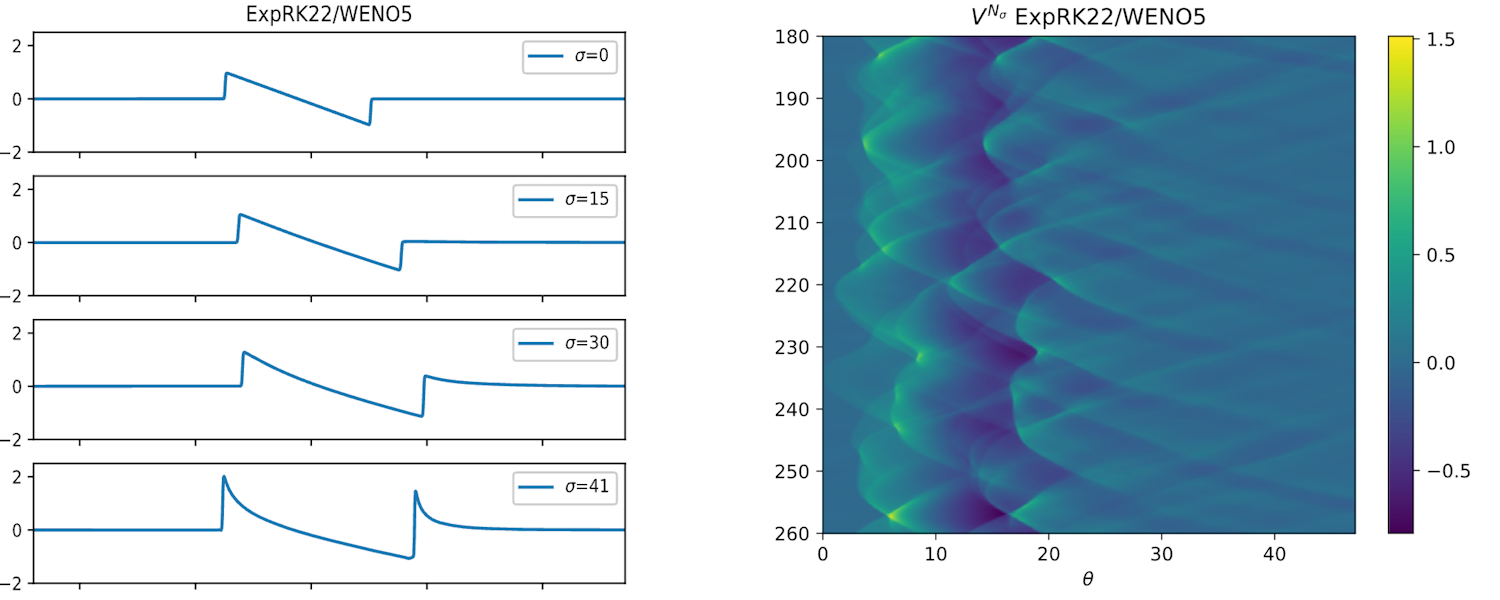
Most physical, biological, and engineering phenomena can be modeled by partial differential equations (PDEs). Time integrators are numerical methods that advance the solution of these equations from one time step to the next. Because many such problems are stiff, explicit integrators often require prohibitively small time steps and therefore become inefficient.
We have worked extensively on splitting methods, which decompose a problem into simpler subproblems whose solutions are then combined to obtain an accurate approximation of the dynamics. Although splitting methods can be highly efficient, they often suffer from order reduction in the presence of nontrivial boundary conditions. We developed approaches that avoid this order reduction for diffusion-reaction problems as well as for problems that include transport. For the developed methods, we can rigorously prove the absence of order reduction.
We have further advanced exponential integrators and efficient techniques for computing the required action of matrix functions using Krylov methods, Leja interpolation, and problem-specific approaches. We have explored applications such as magnetohydrodynamics, sonic wave propagation, and drift-kinetic equations, and analyzed the stability of exponential integrators for hyperbolic problems.
We have also developed geometric (structure-preserving) time integrators; for example, we proposed a Hamiltonian splitting scheme for the Vlasov-Maxwell equations and conservative low-rank schemes based on Runge-Kutta time integrators.