Research / Structure preserving numerical algorithms
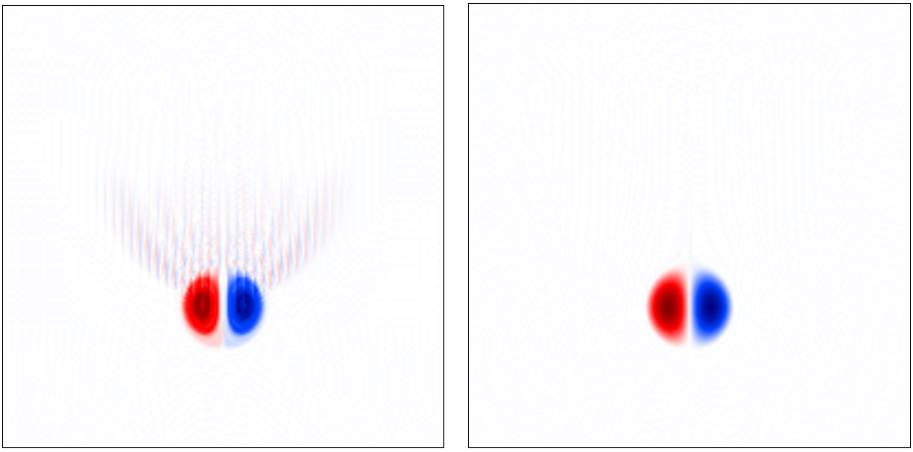
Structure-preserving algorithms are numerical methods that conserve key invariants of the underlying physical system (e.g., mass or energy). By more faithfully mirroring an equation’s intrinsic physical structure, they are often significantly more accurate than traditional methods, especially over long time horizons.
A common structure encountered in many physical applications is that of a Hamiltonian system, which is closely tied to energy conservation. For instance, the seminal splitting scheme for the Vlasov-Poisson equation proposed in the 1976 paper by Cheng & Knorr preserves this Hamiltonian structure. Variants of this scheme have been extensively used for electrostatic kinetic simulations of plasma dynamics. In our own work, we have proposed a Hamiltonian splitting scheme for the full Vlasov-Maxwell system that resolves the complete electromagnetic dynamics while still preserving the underlying Hamiltonian structure.
Another example is the two-dimensional Navier-Stokes equations, which conserve total vorticity, kinetic energy, and enstrophy. Numerical schemes that conserve these quantities are crucial to avoid instabilities and unphysical artifacts during long-time integration — for example, of turbulent plasma dynamics perpendicular to the magnetic field. In this context, we have proposed a high-order discontinuous Galerkin discretization with the desired conservation properties. This method is now implemented in the FELTOR code, developed by Matthias Wiesenberger and Markus Held.
We have also laid the groundwork for structure-preserving dynamical low-rank algorithms. This includes algorithms that conserve mass, momentum, and energy, asymptotic-preserving methods for collisional problems; and conservative methods for radiation transport.