Research / Plasma physics and magnetically confined fusion
Plasmas are gases that are sufficiently hot such that ions and electrons dissociate and can move independently. Plasmas interact strongly with electric and magnetic fields. Magnetic confinement fusion exploits this to confine hot plasma with the goal of producing fusion power. However, plasmas are subject to a number of instabilities that makes this challenging.
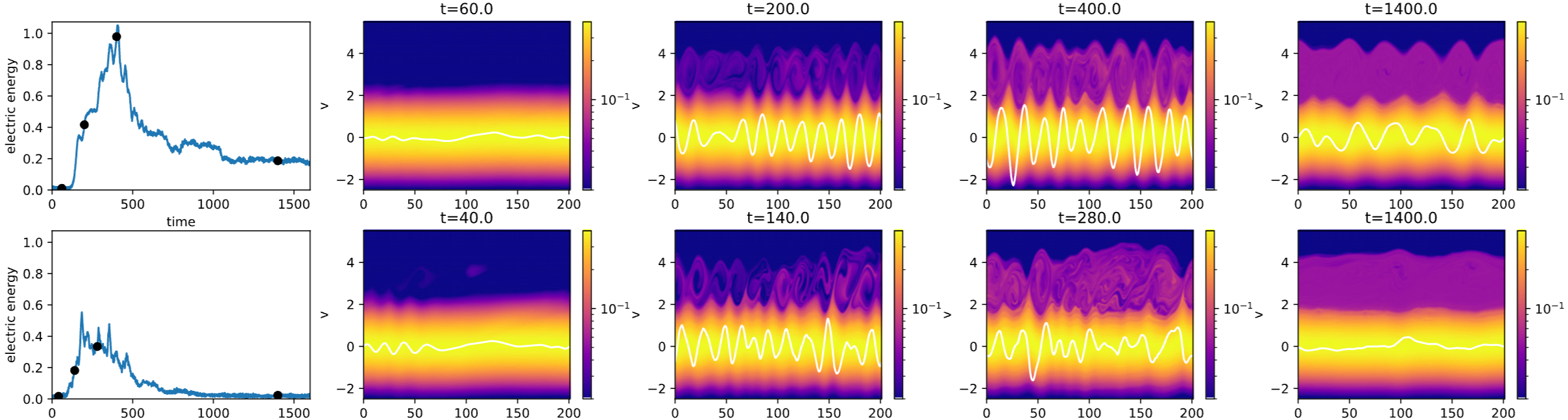
To heat the plasma, energetic particle beams can be injected. This can drive the so-called bump-on-tail instability. In our work, we have shown that modulating the beam density can significantly reduce this instability compared to a uniform beam. To find optimal beam profiles, we combine differential evolution based global optimization with simulations on graphics processing units (GPUs).
In addition, we have worked on finding specific configurations of electric and magnetic fields (based on linear theory and computer simulations) that can suppress or at least mitigate kinetic instabilities. One notable result is that it is possible to suppress instabilities even in cases where the system is linearly unstable. This is achieved by using nonlinear effects to couple electromagnetic and plasma modes that are do not interact in linear theory.
We have also worked on making high-dimensional, and thus usually very expensive, kinetic simulations practical. We have developed semi-Lagrangian discontinuous Galerkin algorithms that are well-suited to modern computer architectures/supercomputers and dynamical low-rank methods as a complexity-reduction technique. Such methods can be used to investigate, for example, Alfvén waves or to compute the plasma dynamics in the scrape-off layer.