Research / Low-rank methods for kinetic equations
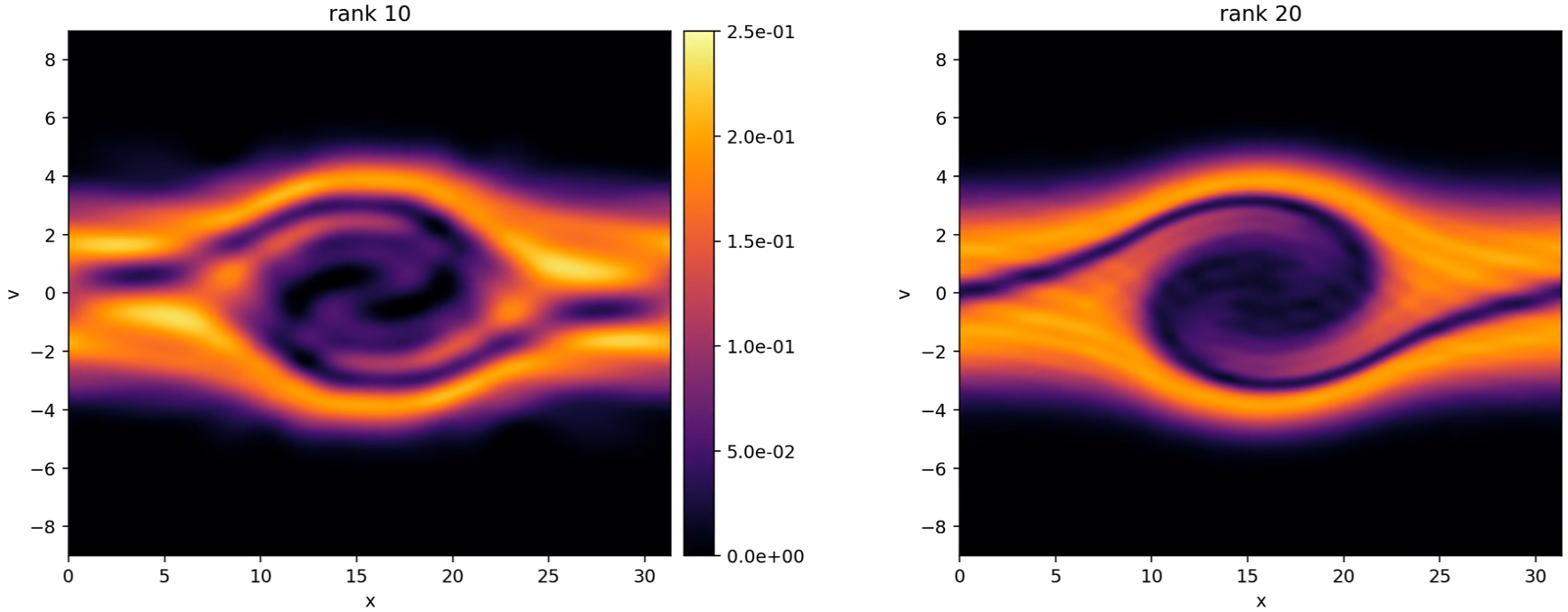
Kinetic equations provide the most accurate description of plasmas and rarefied gases by tracking the full velocity distribution of particles. This approach excels in applications where kinetic effects are important and classic fluid models (such as the Euler or Navier-Stokes equations) are no longer valid. This is often the case for fusion reactors, reentry dynamics, and astrophysical phenomena.
However, solving kinetic equations through computer simulations is extremely expensive due to the high-dimensional phase space (typically 6D, 3D in position and 3D in velocity). Undertaking such simulations often requires am extremely large number of grid points or particles to resolve the relevant dynamics. This leads to memory and computational cost that is prohibitive, except perhaps on the most advanced supercomputers.
We have pioneered the development of dynamical low-rank methods for kinetic equations. In this approach, the 6D distribution function is approximated by lower dimensional basis functions (depending on either space or velocity, but not both) that are evolved in time. This exploits that in many problems kinetic dynamics naturally has a low-rank structure. In fact, in many situations for extremely low rank it can be mathematically shown that the low-rank approximation recovers the underlying fluid or diffusive model (those are so-called asymptotic preserving schemes) while increasing the rank adds more and more kinetic behavior. For an overview see our review article on the topic.For six-dimensional kinetic problems memory and computational cost can often be reduced by many orders of magnitude. We have investigated this for both collisionless and collisional problems. Thus, low-rank methods often succeed in running simulations on desktop computers that otherwise would have required (at the very least) large supercomputers.
We have contributed many important advances in low-rank algorithms, including methods that exactly conserve mass, momentum, and energy, AP methods that can deal with extremely stiff collisions, high-order dynamical low-rank schemes, Von Neumann inspired stability analysis, as well as conducted research on the efficient implementation of such methods on modern computer hardware, such as GPU based systems (see Ensign, our C++/CUDA low-rank framework).