Research / High-performance computing
Fully exploiting modern computing systems and supercomputers is challenging. In recent years, the landscape has shifted toward massively parallel architectures (e.g., graphics processing units, GPUs). Achieving high performance on GPU-based systems and supercomputers requires algorithms that parallelize readily. To fully exploit the computational power available in such systems demands not only efficient implementations but also purpose-built algorithms.
One area where traditional numerical methods fall short is kinetic plasma simulation. Spline-based and spectral methods are common, but both exhibit global data dependencies and therefore do not scale well. We have developed and analyzed semi-Lagrangian discontinuous Galerkin schemes that are often superior to, or competitive with, traditional methods while remaining fully local and are thus well suited for computer modern hardware. Using these methods, we have demonstrated kinetic simulations that scale to thousands of GPUs on leadership-class supercomputers.
In addition to the problems mentioned above, we have accelerated a range of simulations on GPUs, including the Schrödinger equation of quantum mechanics, fluid flow over airfoils, and sonic boom propagation. We also exploit hardware-specific features to accelerate computations. For example, the high single-precision throughput of GPUs, especially on cost-effective consumer cards, can be leveraged by mixed-precision algorithms and some algorithms that were considered infeasible only a few years ago have now become practical thanks to the high arithmetic intensity of modern GPUs.
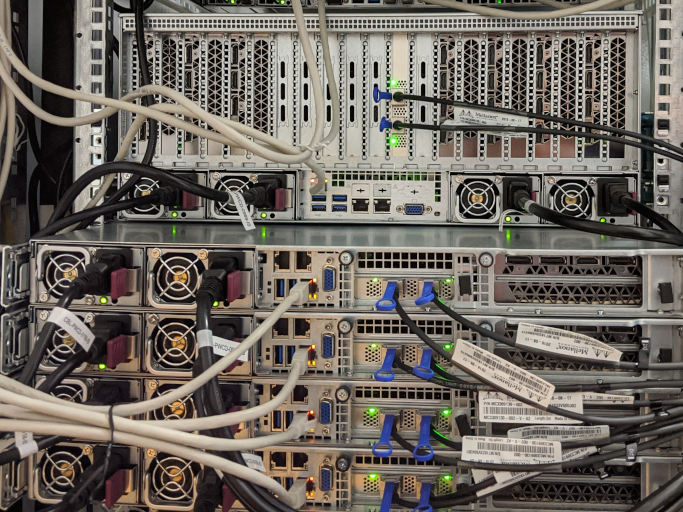
To support this research, we operate two local GPU clusters at the University of Innsbruck and make use of national (e.g., ASC) and international (e.g., JUWELS Booster) high-performance computing systems.